Supporting AM Practitioners
It is important to read these pages strictly from the perspective of the delivery of AM in an organization. As an interdisciplinary field, the full scope of AM is so broad, and interconnects so many different professions, that this framework will overlap with many different jobs and departments in an organization. Many of the AM responsibilities in an organization will also not be performed by a person who is solely dedicated to AM. This is especially the case in smaller organizations. Readers should always keep in mind that the competencies and proficiency levels described in the AMCF are only related to the performance of the relevant AM responsibilities discussed. A complete list of the AM Responsibilities used as the foundation for the AM Competencies and the rest of the AMCF can be found here. Where an individual has AM Responsibilities, and only for the scope of those responsibilities, that person is referred to as an “AM Practitioner” in the AMCF.

Readers should recognize that many individuals will be proficient in other competencies, whether related to their background, profession, or non-AM duties in the organization. Many will have greater or lesser proficiency in competencies similar to or overlapping with those identified. Some may have job requirements for certifications, professional designations, or technical training programs. These competencies and requirements will often be related to underlying technical knowledge and skills that, while important for understanding and engaging in the practice of AM, may not directly relate to AM responsibilities. These topics are therefore outside the scope of the AMCF.
Further, the AMCF does not specify AM-specific requirements for certifications, professional designations, or technical training programs. Where such programs are identified they are for purposes of example only and should not be considered an endorsement, an assessment of their content or outcomes, nor a comprehensive listing. There are also regional and local requirements that cannot be accounted for in such a broadly focused document. These are important considerations for any organization and any implementation of the AMCF will need to include an exploration of these additional aspects of each organization’s needs. However, they are also beyond the scope of the AMCF.
Readers should also be aware that the AMCF is intended as a guide for developing the AM Competencies rather than a prescriptive set of requirements for performing AM. The AM Competencies will show organizations and individuals how to practice AM better. It should not be expected that every organization or individual practicing AM will have fully developed the AM Competencies or have a competency management program in place. This is why goal #2 of the AMCF program specifies that these are the competencies that “a community’s workforce should possess to best deliver their AM programs.” Take the AMCF as a starting point in an AM Competency development journey.
Supporting Individuals in AM-Adjacent Roles

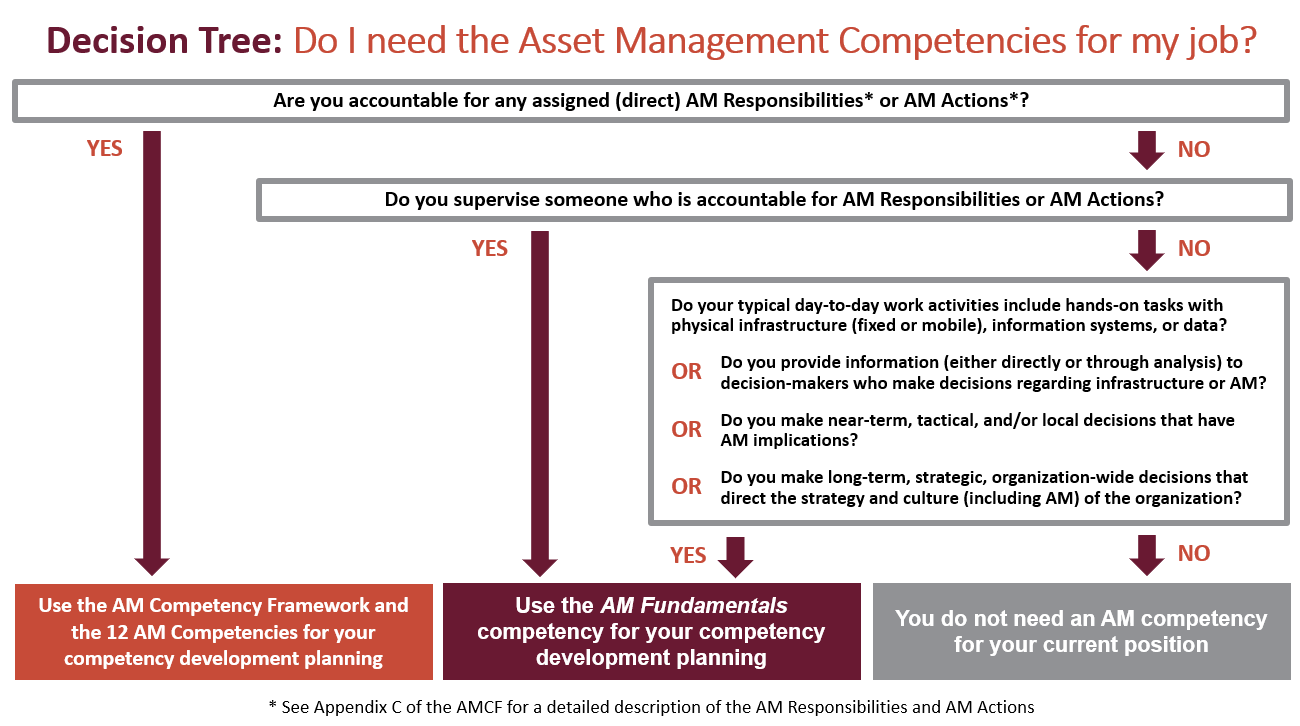
As described previously, the AMCF is addressed exclusively to AM Practitioners. Many roles, however, fall outside the mandate of the AMCF and yet are still expected to apply fundamental AM principles and concepts within the scope of a non-AM role in a public sector infrastructure-managing organization. In these “AM-adjacent” roles, an individual must provide an appropriate level of support to AM practitioners, using a broad, high-level understanding of AM. They will often provide practical advice or support to others as to interaction of their organizational functional area with AM issues and situations.
The Asset Management Fundamentals competency has therefore been developed to provide a broad, high-level overview of the type of information and capability that is expected of those who are in these AM-adjacent roles. Examples of the types of roles and their general responsibilities relating to AM are shown below in four broad groupings. This list of roles is not complete but should provide enough information so that you can see that there are many types of roles with a relationship with Asset Management.
Example AM-Adjacent Roles and Responsibilities:
– Truck Driver – Public Works Labourer – Mechanic | – Recognize how your activities may impact or relate to infrastructure management and sustainable service delivery. – Use hands-on insight about infrastructure to identify issues or opportunities to improve operations or mitigate costs or risks relating to AM. |
– Accounts Payable Clerk – Business Solutions Analyst – Auditor | – Perform routine actions, follow processes, or provide information or analysis that feeds into AM decisions or drives the AM activities of others. – Utilize information from AM practitioners to plan required actions. |
– (Non-AM) Manager – Fire Chief – Senior Technical Specialist | – Incorporate AM considerations into a wide range of short-term, local, tactical decisions. – Provide input or guidance to other decision makers on long term approaches/strategies affecting AM (e.g., policy). |
– CAO / City Manager – C-level and VP-level Executives – (Non-AM) Directors | – Make decisions with significant and strategic impact on the organization’s AM activities. Decisions may have external impacts. – Understand and critique significant or new approaches to AM and integrate AM into the breadth of decisions made within the scope of your role. – Support and enable strategic engagement of relevant staff, community members, and others to support AM. |